
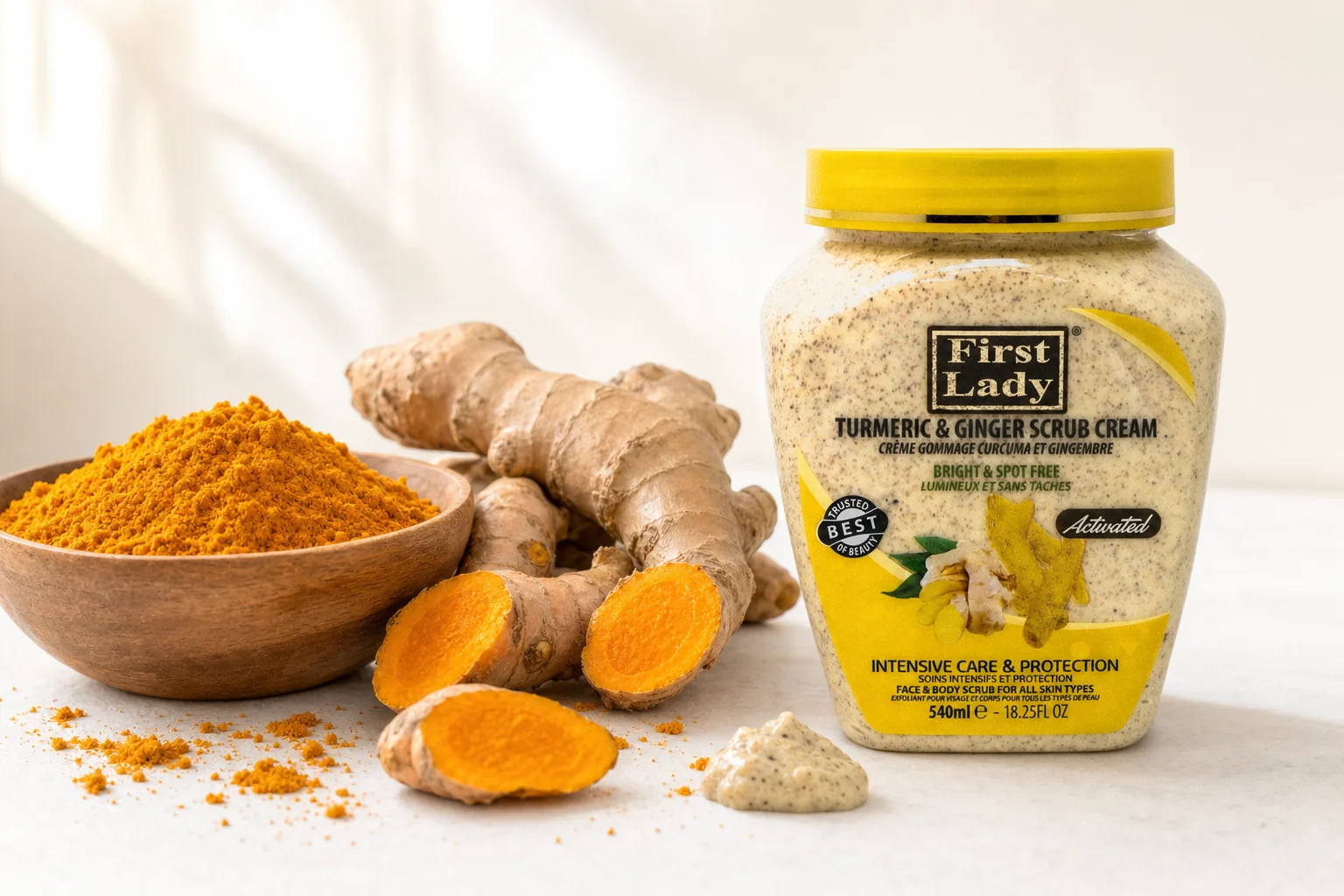
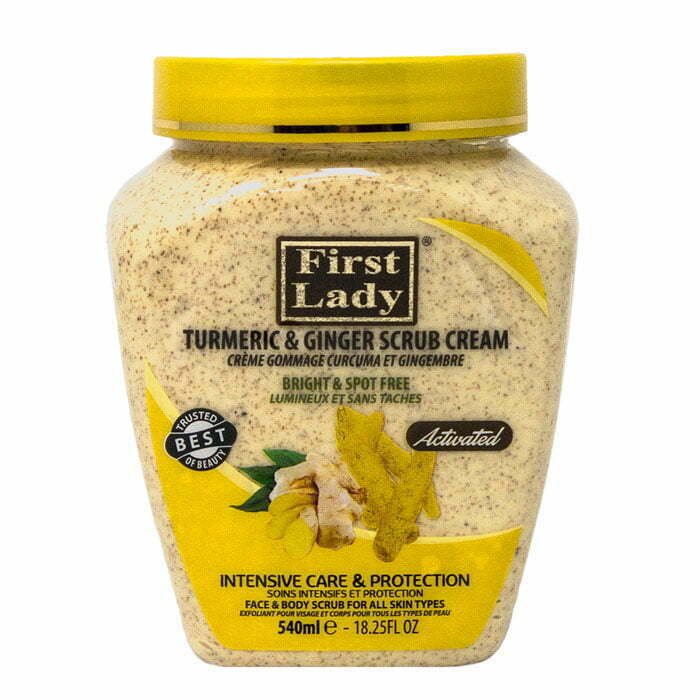
Few natural ingredient pairings have attracted as much scientific attention in recent years as turmeric and ginger. Both roots have anchored South Asian skincare traditions for centuries. Consequently, modern dermatological research has begun to catch up with what generations of households already knew: these two spices do genuinely interesting things for the skin. The First Lady Turmeric & Ginger Scrub Cream for Face & Body brings that combination into a single 540ml exfoliating formula, and in this article we’ll look at exactly why turmeric and ginger earn their place in a weekly skincare routine, with reference to the peer-reviewed research behind each claim.
Before diving into the benefits, it’s worth clarifying what a scrub actually does. Physical exfoliants mechanically lift away the outermost layer of dead skin cells (the stratum corneum), speeding up the skin’s natural renewal process. According to the British Skin Foundation, regular, gentle exfoliation can improve the appearance of dull or congested skin by encouraging faster cell turnover, as long as you avoid excessive friction. Combine that mechanical action with two botanicals independently well-studied for their bioactive compounds, and you get a scrub that does more than buff away flaky skin.
1. Turmeric’s Curcumin Content Supports a Brighter Complexion
Turmeric (Curcuma longa) owes most of its skin benefits to curcumin, its principal bioactive polyphenol. A systematic review published in Phytotherapy Research by Vaughn, Branum and Sivamani (2016) examined the clinical evidence for turmeric’s effects on skin health. It found consistent support across multiple trials for its role in improving skin brightness and evening out tone, largely attributed to curcumin’s antioxidant capacity and its influence on pigmentation-related pathways. Consequently, turmeric has become a mainstay ingredient in formulations targeting uneven pigmentation and a lacklustre complexion, which is precisely the territory the First Lady Turmeric & Ginger Scrub is designed to address.
2. Anti-Inflammatory Action Helps Calm Reactive Skin
One of the most consistently replicated findings in curcumin research is its anti-inflammatory activity. Chainani-Wu (2003), writing in the Journal of Alternative and Complementary Medicine, reviewed curcumin’s safety and anti-inflammatory profile and concluded that it modulates several inflammatory pathways in the body, including those implicated in skin irritation and redness. For anyone whose skin tends to flare up after exfoliation, that distinction matters. A scrub built around an anti-inflammatory active is, in principle, better positioned to soothe skin during the buffing process rather than aggravate it.
3. Ginger’s Gingerols Provide a Complementary Antioxidant Boost
Where turmeric brings curcumin, ginger (Zingiber officinale) brings gingerols and shogaols, its own family of bioactive phenolic compounds. A review by Semwal, Semwal, Combrinck and Viljoen (2015) in Phytochemistry detailed how gingerols function as potent antioxidants, capable of neutralising free radicals that would otherwise contribute to oxidative stress in skin tissue. Oxidative stress is widely implicated in premature skin ageing. Hence, an ingredient that helps counter it, layered on top of turmeric’s own antioxidant effects, gives this scrub a genuinely complementary two-ingredient antioxidant profile rather than a repetitive one.
4. The Combination May Support a More Even-Looking Skin Tone
Uneven skin tone, whether from sun exposure, post-blemish marks or general dullness, is one of the most commonly cited skincare concerns among UK consumers. Because turmeric and ginger act on overlapping but distinct mechanisms (pigmentation-related pathways and oxidative stress reduction respectively), using them together in a single formulation is a rational combination rather than simple ingredient stacking. This is reflected in the product description for the First Lady Turmeric & Ginger Scrub, which is formulated to “brighten, cleanse and promote spot free skin” across both face and body.
5. Physical Exfoliation Encourages Healthy Cell Turnover
Don’t attribute every benefit purely to the actives. The scrub format itself does real work. As skin cells move through their natural renewal cycle, dead cells can accumulate on the surface, contributing to a rough texture and a tired-looking complexion. Research summarised by the NHS on general skin health notes that gentle physical exfoliation, used appropriately and not excessively, can help remove this build-up and support smoother-looking skin (see nhs.uk for general skincare guidance). Because the First Lady formula is a cream-based scrub rather than a harsh grit-based one, it’s built to deliver that mechanical benefit without being overly abrasive on either the face or the body.
6. Suitable Use Across Face and Body for a Consistent Routine
A common skincare frustration is needing separate products for the face and the rest of the body, especially when you want to maintain a consistent tone across visible skin. The First Lady Turmeric & Ginger Scrub Cream is formulated for use on both face and body, in a generous 540ml size, which means the same antioxidant and exfoliating benefits can be applied consistently rather than being limited to one area. For anyone targeting a uniform, brighter look, that consistency matters more than it might initially seem.
7. A Sensory, Spa-Like Experience Supports Skincare Consistency
Finally, it’s worth acknowledging a less clinical but equally important factor: adherence. Skincare only works if you use it regularly, and a product that feels genuinely pleasant is far more likely to become a fixture in someone’s weekly routine than something left at the back of a cabinet. The First Lady scrub is fragranced and formulated to deliver, in the brand’s own words, “a spa-like experience at home.” That sensory element, paired with the underlying botanical research, is part of what turns a single-use scrub into a repeatable weekly habit, which is ultimately where the cumulative benefits of turmeric and ginger are realised.
How to Use a Turmeric Ginger Skin Scrub Effectively
To get the most from this formula, dermatology-aligned best practice generally suggests:
- Frequency: Two to three times per week is typically sufficient for most skin types; daily use of any physical exfoliant can compromise the skin barrier.
- Application: Apply to damp skin using gentle, circular motions, avoiding excessive pressure, particularly on the face.
- Aftercare: Follow with a moisturiser, since exfoliation temporarily increases the skin’s need for hydration as the outer layer is refreshed.
- Patch testing: As with any new active-ingredient product, a patch test on a small area of skin is a sensible first step, especially for those with known sensitivities.
The First Lady Turmeric & Ginger Scrub is formulated for all skin types, but that guidance still holds as a general principle of good skincare practice.
The Bottom Line
Turmeric and ginger aren’t a fashionable pairing invented for marketing purposes; they’re two of the most extensively researched botanicals in dermatological science, each bringing a distinct but complementary mechanism to the table. Turmeric’s curcumin supports brightening and calms inflammation, while ginger’s gingerols reinforce the antioxidant defence against oxidative stress. Layer that active profile onto a gentle physical exfoliation base, and you get a scrub that addresses dullness, uneven tone, and rough texture from multiple angles at once.
For anyone looking to add a simple, research-informed step to their weekly routine, the First Lady Turmeric & Ginger Scrub Cream for Face & Body offers an accessible way to put that science into practice.
Ready to add it to your weekly routine? Shop the Turmeric & Ginger Scrub Cream at First Lady London →
Related reading: Turmeric & Ginger Scrub Cream: Benefits for Bright, Spot-Free Skin
References
- Vaughn AR, Branum A, Sivamani RK. Effects of Turmeric (Curcuma longa) on Skin Health: A Systematic Review of the Clinical Evidence. Phytotherapy Research. 2016;30(8):1243-1264.
- Chainani-Wu N. Safety and Anti-Inflammatory Activity of Curcumin. Journal of Alternative and Complementary Medicine. 2003;9(1):161-168.
- Semwal RB, Semwal DK, Combrinck S, Viljoen AM. Gingerols and Shogaols: Important Nutraceutical Principles from Ginger. Phytochemistry. 2015;117:554-568.
- Akram M, Shahab-Uddin, Ahmed A, et al. Curcuma longa and Curcumin: A Review Article. Romanian Journal of Biological Sciences. 2010;55(2):65-70.
- NHS – Skincare guidance.
- British Skin Foundation
- Royal Society of Chemistry
Leave a Reply