
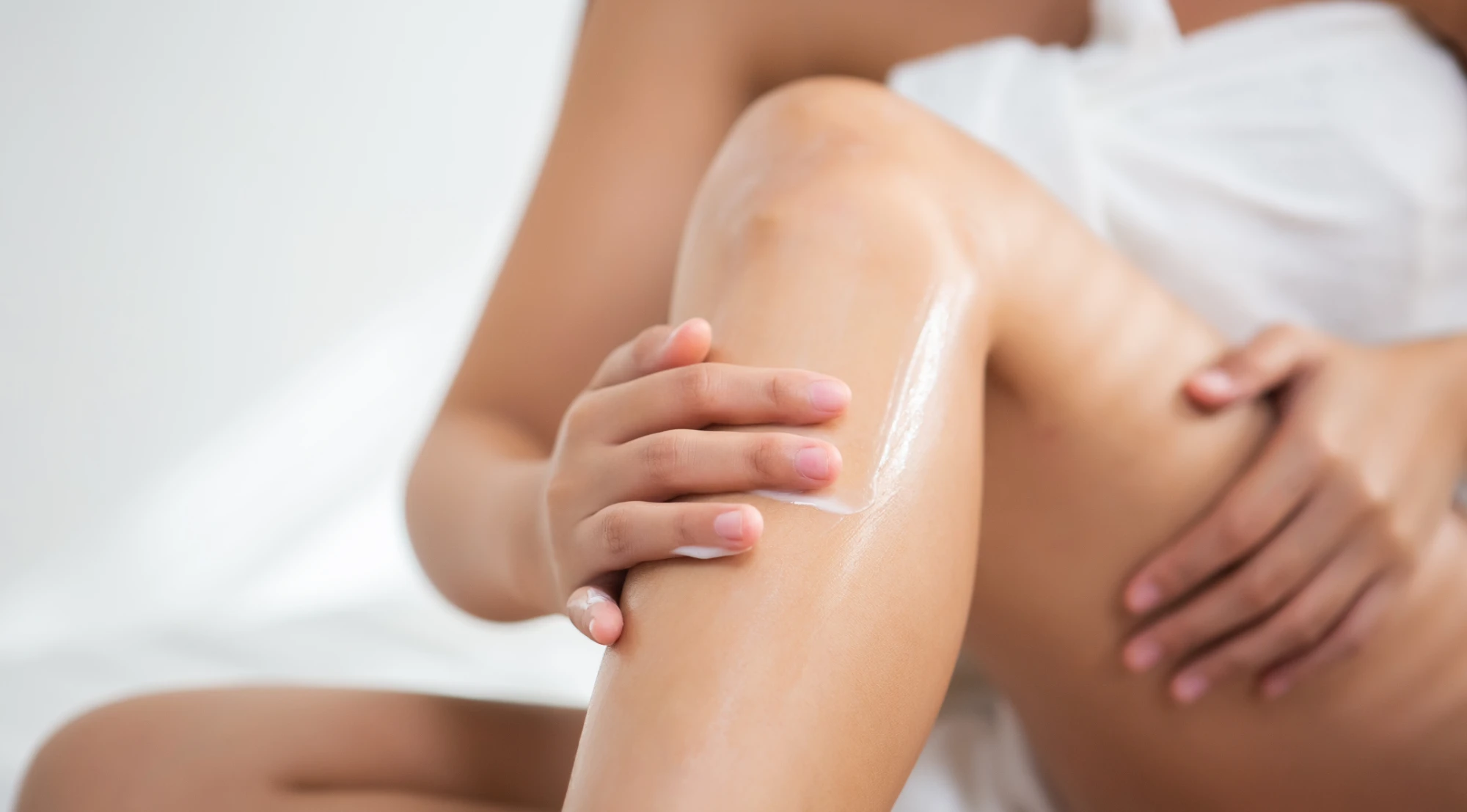
Dry skin can feel tight after showering, look rough on your legs or leave your elbows and knees needing extra care. A consistent moisturising routine is a simple way to help keep your skin feeling soft and comfortable.
First Lady Daily Moisturising Fragrance-Free Hyaluronic Acid Lotion combines hyaluronic acid, emollients and antioxidants in a lightweight, non-greasy formula. Available in a 1000ml bottle, it is designed for everyday body moisturising, with dry and sensitive skin identified as its intended audience.
Understanding how moisturisers work can help you make more informed choices. Here is what scientific research tells us about hydration, the skin barrier and choosing fragrance-free care. For more on this ingredient, see our guide to moisturising hyaluronic acid lotion for healthier skin.
Why Does Skin Become Dry?
The outermost layer of your skin, called the stratum corneum, helps protect your body and regulate moisture loss. It contains skin cells surrounded by a mixture of lipids, including ceramides, cholesterol and fatty acids.
These components work together to form a protective barrier. A scientific review by Proksch and colleagues explains how this structure limits water loss and helps protect against external substances. Changes in its organisation can affect how well the barrier works.
Dryness can have several causes, so choosing a moisturiser involves more than finding one appealing ingredient. The formula should suit the condition of your skin and the areas where you intend to use it.
A dermatology position paper by Augustin and colleagues recommends combining hydrating and lipid-replenishing components in dry-skin care. It also highlights that people with greater dryness may need richer formulations.
For everyday body care, this means paying attention to both moisture and skin comfort.
What Does Hyaluronic Acid Do?
Hyaluronic acid is naturally present in the body and has a strong ability to bind water. In skincare, it is used as a humectant, an ingredient that helps attract and retain moisture.
Despite its name, hyaluronic acid is not an exfoliating acid. Its role in a moisturiser is hydration.
In the review by Papakonstantinou and colleagues, hyaluronic acid is highlighted as a key molecule in skin aging. The ingredient is important in skin moisture because it contains water-retaining properties. This helps explain why it is widely used in hydrating skincare.
First Lady’s lotion includes hyaluronic acid as part of its moisturising blend. It brings this ingredient into a daily body care product rather than requiring a separate hydrating step.
What Have Clinical Studies Found About Topical Hyaluronic Acid?
Research has examined whether applying hyaluronic acid in a cream or lotion can improve measured skin hydration.
In a 2011 study involving 76 women, researchers tested creams containing 0.1% hyaluronic acid of different molecular weights. Participants applied a test cream around one eye and a control cream around the other for 60 days.
The hyaluronic acid creams improved measured hydration and elasticity compared with the control. Although this was a facial study, it provides evidence that topical hyaluronic acid can contribute to hydration in a suitably formulated product.
A more recent 2024 double-blind, randomised trial examined lotions on the dry leg skin of 36 adults aged 60 to 80. Researchers compared low molecular weight hyaluronic acid, high molecular weight hyaluronic acid and a lotion base without the added hyaluronic acid.
After four weeks, the low molecular weight formulation produced higher hydration measurements than the other formulations. However, the groups did not differ significantly in measured water loss or clinical dryness scores.
This distinction matters: an improvement in hydration does not automatically establish every other skincare benefit. These studies support hyaluronic acid’s potential in moisturising formulations, but they did not test the First Lady lotion.
Why the Whole Moisturising Formula Matters
A lotion works through its complete formula, rather than one ingredient alone.
- Humectants help attract and hold water.
- Emollients help soften skin and improve its feel.
- Occlusive ingredients help reduce moisture loss from the surface.
A moisturiser may combine these functions to provide balanced care. Its performance depends on the ingredients, their amounts and how they are formulated together.
First Lady’s lotion contains a blend of hyaluronic acid, emollients and antioxidants. The hyaluronic acid and emollients connect directly with the moisturising approach discussed in the research.
Why Choose a Fragrance-Free Body Lotion?
Fragrance adds scent to skincare, but it is not needed for a product to moisturise.
For some people, fragrance-free care is simply a preference. For others, avoiding particular fragrance ingredients is important because those ingredients can trigger allergic contact dermatitis.
A 2024 scientific review by Sukakul and colleagues examines fragrance contact allergy, including sources of exposure and the use of patch testing to identify relevant allergens. It explains why recognising the ingredients responsible is important when managing fragrance allergy.
Choosing a fragrance-free body lotion avoids added perfume in that part of your routine. However, it does not guarantee that every person with sensitive skin will tolerate the formula. Other ingredients can also cause reactions.
First Lady’s fragrance-free lotion offers an option for people who want to moisturise without adding a perfumed scent to their body care.
Fragrance-Free and Unscented: What Is the Difference?
The two terms can sound similar, but they are not necessarily interchangeable.
An unscented product may contain ingredients that mask the smell of its formula. A fragrance-free product is intended to avoid added fragrance.
The American Academy of Dermatology recommends looking for fragrance-free skincare when caring for dry, sensitive skin and notes that unscented products may contain odour-masking ingredients.
A fragrance-free lotion may still have a mild smell from its ingredients. That does not necessarily mean perfume has been added.
A Lotion Texture That Fits Your Routine
The texture of a moisturiser can influence whether you enjoy using it regularly. First Lady describes the lotion as lightweight, non-greasy and quick to absorb. These features may appeal if you prefer a lotion for everyday body care.
Keep it somewhere convenient so that moisturising becomes part of getting ready after bathing. Give areas that tend to feel dry, such as your lower legs, elbows and knees, extra attention.
For very dry skin, a richer cream or ointment may be more appropriate. The aim is to choose a texture that meets your skin’s needs and feels comfortable enough to use consistently.
How to Make the Most of Your Moisturising Routine
Follow the directions on the product label. General dry-skin care guidance includes:
- Use warm water when bathing. Avoid very hot showers.
- Pat your skin dry gently. Leave it slightly damp.
- Apply moisturiser after bathing. This helps retain moisture.
- Pay attention to dry areas. Massage the product over the areas you are caring for.
- Keep the routine consistent. Reapply according to the label and your skin’s needs.
The American Academy of Dermatology recommends short, warm baths or showers and applying moisturiser while skin is still damp.
If your skin reacts easily, introduce a new product on a small area first. Stop using it if irritation develops.
Everyday Moisture Without Added Perfume
Scientific research gives us a clearer understanding of why moisturising matters: hydration, softening ingredients and the skin barrier all contribute to comfortable skin.
First Lady Daily Moisturising Fragrance-Free Hyaluronic Acid Lotion brings hyaluronic acid and emollients together in an everyday body moisturiser. Its fragrance-free formula offers a practical choice for people who prefer body care without added perfume.
Explore First Lady’s Fragrance-Free Hyaluronic Acid Lotion and make daily moisturising part of your routine.
References
- Proksch, E., Brandner, J.M. & Jensen, J.-M. (2008). The skin: an indispensable barrier. Experimental Dermatology, 17(12), 1063-1072. doi:10.1111/j.1600-0625.2008.00786.x
- Augustin, M. et al. (2019). Diagnosis and treatment of xerosis cutis – a position paper. Journal der Deutschen Dermatologischen Gesellschaft, 17(Suppl. 7), 3-33. doi:10.1111/ddg.13906
- Papakonstantinou, E., Roth, M. & Karakiulakis, G. (2012). Hyaluronic acid: A key molecule in skin aging. Dermato-Endocrinology, 4(3), 253-258. doi:10.4161/derm.21923
- Pavicic, T. et al. (2011). Efficacy of cream-based novel formulations of hyaluronic acid of different molecular weights in anti-wrinkle treatment. Journal of Drugs in Dermatology, 10(9), 990-1000. Read the study abstract
- Muhammad, P. et al. (2024). Effectiveness of topical hyaluronic acid of different molecular weights in xerosis cutis treatment in elderly: a double-blind, randomized controlled trial. Archives of Dermatological Research, 316(6), 329. doi:10.1007/s00403-024-03003-2
- Sethi, A., Kaur, T., Malhotra, S.K. & Gambhir, M.L. (2016). Moisturizers: The Slippery Road. Indian Journal of Dermatology, 61(3), 279-287. doi:10.4103/0019-5154.182427
- Sukakul, T., Bruze, M. & Svedman, C. (2024). Fragrance Contact Allergy – A Review Focusing on Patch Testing. Acta Dermato-Venereologica, 104, adv40332. Read the review
- American Academy of Dermatology. Dermatologists’ top tips for relieving dry skin. Read the practical guidance
Leave a Reply