
AHAs vs. BHAs: Which Exfoliant Is Right for You?
A plain-English guide to the differences between AHAs and BHAs, who each one suits, and how to use them safely.

Short answer: AHAs (such as glycolic and lactic acid) work on the skin’s surface and are often chosen for dullness, rough texture and uneven tone. BHAs (such as salicylic acid) can work inside the pore and are often chosen for oily, blackhead-prone skin. Many people use just one, and some use both at different times. If your skin is sensitive, start with one and introduce it slowly.
Exfoliating acids help loosen dead skin cells so skin can look smoother and brighter. The two most popular types are AHAs (alpha hydroxy acids) and BHAs (beta hydroxy acids). This guide compares them, answers the questions people ask most, and shows where First Lady London’s AHA products fit.
Understanding the Basics: What Are AHAs and BHAs?
AHAs (alpha hydroxy acids) are water-soluble acids derived from fruits and milk. They mainly work on the skin’s surface, loosening the bonds between dead skin cells and helping them shed. Common AHAs include glycolic acid, lactic acid, mandelic acid and citric acid.
The NHS explains how acids are used on skin in its chemical peel guidance.
BHAs (beta hydroxy acids) are oil-soluble, so they can move into pores to help clear excess oil and debris. Salicylic acid is the best-known BHA, and it is commonly used for oily, acne-prone skin.

How to Choose: Which One Is Right for Your Skin?
Choose AHAs if:
- You have dry, rough or dull-looking skin.
- You want to help fade the look of dark spots or uneven tone.
- You want a more radiant, even-looking complexion.
- You want to help smooth the look of fine lines.
AHAs such as glycolic and lactic acid help loosen dead skin cells, which may support smoother, brighter-looking skin (see the British Skin Foundation for general skin advice).
Choose BHAs if:
- You have oily or acne-prone skin.
- You struggle with blackheads and enlarged-looking pores.
- You want something designed for congested skin.
Salicylic acid is oil-soluble, so it can work inside the pore, which is why it is often chosen for congested skin types.
First Lady London’s AHA Products for Brightening
Our Fast Active Maxi Tone Collection features AHA products designed to help:
- Exfoliate dead skin cells gently.
- Improve the look of skin texture and smoothness.
- Fade the look of dark spots and uneven tone.
- Reveal a more luminous, even-looking complexion.
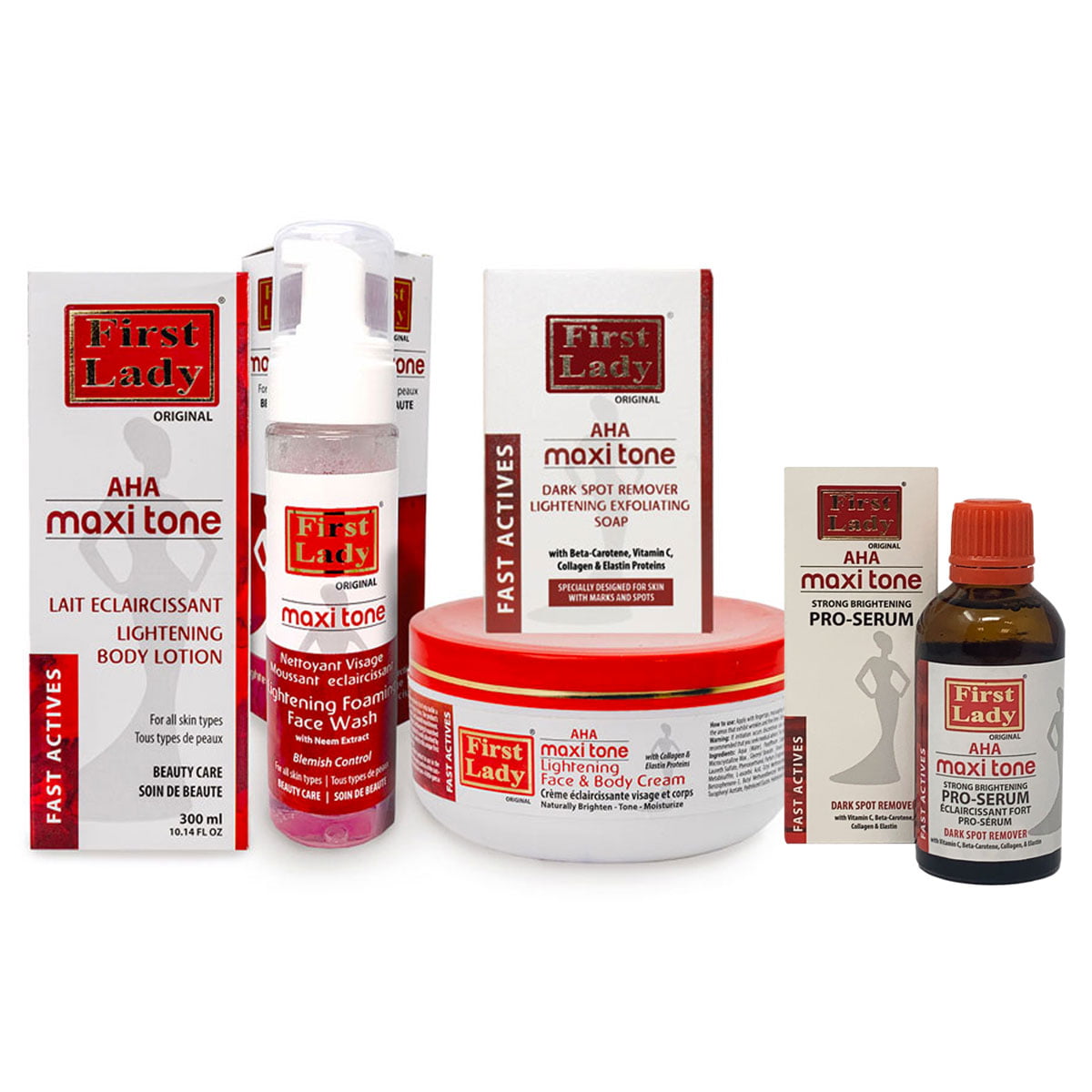
Our range includes:
- First Lady Fast Active AHA Maxi Tone Brightening Body Lotion: designed for dull, uneven-looking skin.
- First Lady Fast Active AHA Maxi Tone Brightening Face & Body Cream: nourishes while helping to brighten.
- First Lady Fast Active AHA Maxi Tone Brightening Exfoliating Soap: combines cleansing with gentle exfoliation.
- First Lady AHA Maxi Tone Strong Brightening PRO Serum: a targeted serum for uneven-looking areas.
- Maxi Tone Brightening Self-Foaming Face Wash: for daily brightening maintenance.
These are AHA-based products, so use them as directed, patch test first and always use sunscreen in the daytime.
-
 -49% Off
£49.95Original price was: £49.95.£25.39Current price is: £25.39.First Lady AHA maxi tone brightening face and body kit is a 5 pcs kit which promotes radiant glowing skin, clear skin and clean skin.
Read our blog: The Science Behind Lactic Acid: Illuminating Your Skin’s Radiance
What the Research Says About AHAs
Research has looked at glycolic acid, a common AHA, and its effects on photoaged skin (see the British Journal of Dermatology). AHAs also create a smoother surface, which may help moisturisers and serums sit better on the skin.
How to Incorporate AHA Exfoliants into Your Routine
- Start slowly: begin with every other night, or less, to let your skin adjust.
- Apply at night: AHAs can increase sun sensitivity, so night-time use is usually recommended.
- Use sunscreen: protect exfoliated skin with a broad-spectrum SPF during the day.
- Moisturise: follow with a hydrating product, such as our shea butter lotion.
AHA or BHA: your questions answered
Should I use AHA or BHA?
It depends on your main concern. If your skin is dull, rough or uneven, an AHA is usually the first choice. If it is oily with blackheads or breakouts, a BHA is usually the better fit. If your skin is dry or sensitive, start with a gentle AHA such as lactic acid, patch test, and ask a pharmacist or dermatologist if you are unsure.
Which is better for ageing skin, BHA or AHA?
AHAs are usually the first choice for texture, dullness and fine lines because they work on the skin’s surface. BHAs are less often chosen for this unless your skin is also oily. Either way, daily sunscreen matters more than any acid.
Is AHA or BHA better for blackheads?
BHA is usually preferred because it is oil-soluble and can work inside pores. An AHA can also help if a build-up of dead skin is adding to the problem.
Do I need both an AHA and a BHA in my routine?
Not necessarily. Some people with combination skin use both, but on different nights rather than layered together. Introduce one at a time, and stop if you notice stinging, redness or peeling.
Common Myths About AHAs and BHAs
Myth 1: Exfoliating daily is better.
Truth: over-exfoliating can upset the skin barrier. Many skin experts suggest starting with two to three times a week at most.
Myth 2: AHAs and BHAs are only for acne.
Truth: BHAs are often used for breakouts, while AHAs are widely used for dullness, rough texture and uneven tone.
Myth 3: Natural exfoliants are always gentler.
Truth: when well formulated, chemical exfoliants can be more even and predictable than rough physical scrubs.
Conclusion: Which Should You Choose?
The right choice depends on your skin. If your goal is to help brighten dull skin, fade the look of dark spots, smooth the look of fine lines and get a more even-looking glow, an AHA is a good place to start. For oily, blackhead-prone skin, a BHA may suit you better.
Ready to start? Explore our AHA-powered Maxi Tone range.
Sources: