
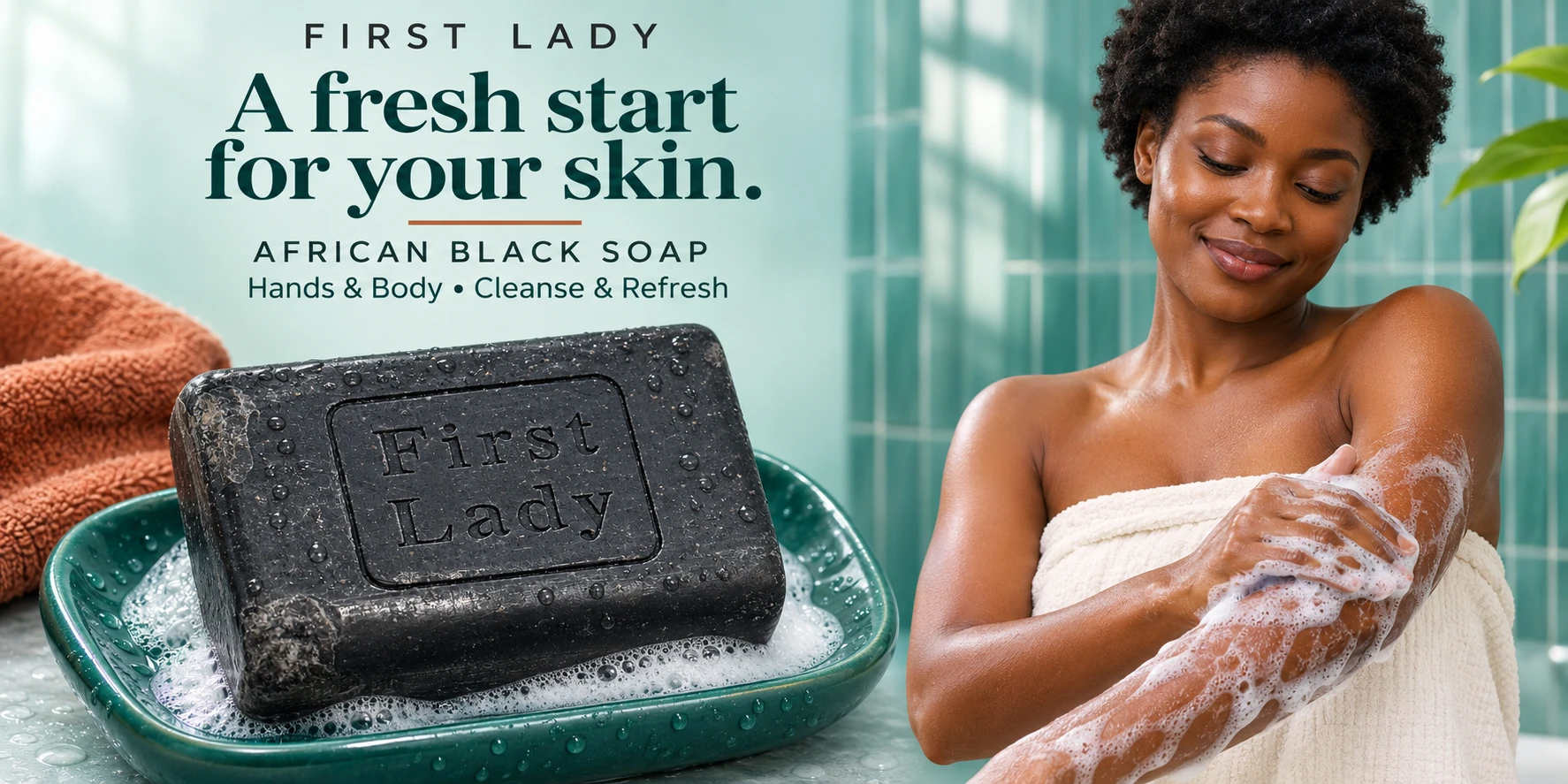
Refresh your routine with First Lady African Black Soap: a traditionally inspired cleansing bar with shea butter, vitamin E, arbutin and apricot kernel extract.
A satisfying skincare routine starts with cleansing. Whether you are washing your face in the morning or enjoying a shower after a busy day, it is an opportunity to refresh your skin and take a moment for yourself.
First Lady African Black Soap brings face and body cleansing together in a convenient 200g bar. Designed to cleanse deeply and exfoliate gently, it is an affordable way to introduce these familiar skincare ingredients into your washing routine.
A fresh start for your skin
Sweat, excess oil and everyday dirt can collect on the skin’s surface. Cleansing helps lift away these residues so they can be rinsed off with water.
Scientific literature explains that effective cleansing relies on ingredients that interact with both oil and water, helping remove unwanted material from the skin. The best approach combines thorough washing with a gentle touch, respecting the skin’s protective barrier (Ananthapadmanabhan et al., 2004).
Think of cleansing as the foundation of your routine: wash, rinse, moisturise and enjoy that freshly cared-for feeling.
The key ingredients in First Lady African Black Soap
Shea butter: loved for its softening properties
Shea butter is a well known emollient used in skincare. Emollients help soften and smooth the skin’s surface, making them popular additions to products designed with skin comfort in mind.
A review published in Frontiers in Pharmacology examined clinical research into vegetable oils and butters, including shea butter. It describes their potential roles in skin conditioning and moisture care, while recognising that effects vary with the ingredient and how it is applied (Poljšak and Kočevar Glavač, 2022).
Why it appeals: shea butter is a familiar choice for individuals who enjoy rich, skin conditioning ingredients.
Vitamin E: a recognised skincare antioxidant
Vitamin E has a long history in cosmetic formulations. It is a fat-soluble antioxidant, meaning it can help neutralise free radicals involved in oxidative stress.
Keen and Hassan (2016), writing in the Indian Dermatology Online Journal, describe vitamin E’s antioxidant activity and its widespread use in skincare. This ingredient research helps explain its enduring popularity in beauty products.
Why it appeals: vitamin E adds a recognised antioxidant ingredient to the formula.
Arbutin: researched for its role in skin tone
Arbutin is a cosmetic ingredient associated with products aimed at a brighter-looking, more even-toned complexion.
In a laboratory study, Maeda and Fukuda (1996) found that arbutin reduced tyrosinase activity in cultured human pigment-producing cells. Tyrosinase is an enzyme involved in melanin production. These findings explain the scientific interest in arbutin for cosmetic formulations.
Why it appeals: arbutin is an ingredient worth recognising when exploring skincare focused on the appearance of uneven tone.
Apricot kernel extract: part of the exfoliating blend
Apricot kernel extract contains exfoliating power. Exfoliation removes dead cells from the skin’s surface. Keeping the process gentle is essential: light pressure and a routine suited to your skin are more useful than vigorous scrubbing.
Why it appeals: combining cleansing and exfoliation can make your washing routine feel simple and convenient.
Why add this soap to your routine?
First Lady African Black Soap offers a practical combination of features:
- Face and body use: convenient cleansing in one bar.
- Deep cleansing: designed to wash away everyday impurities.
- Gentle exfoliation: an easy addition to your cleansing ritual.
- Four featured ingredients: shea butter, vitamin E, arbutin and apricot kernel extract.
- A generous 200g size: a straightforward choice for your bathroom shelf.
How to use African black soap on your face and body
- Wet your hands and skin with lukewarm water.
- Work the soap into a lather between your hands.
- Massage the lather gently over your face or body, avoiding the eyes.
- Rinse thoroughly and pat dry.
- Apply a suitable moisturiser afterwards.
Follow the label and choose a frequency your skin tolerates comfortably. Avoid vigorous scrubbing or layering several exfoliating products in the same session.
The American Academy of Dermatology recommends gentle exfoliation and moisturising afterwards to help keep skin comfortable (American Academy of Dermatology, n.d.).
Patch test before first use and stop if irritation occurs. Use SPF 30+ on exposed skin during the day.

First Lady African Black Soap
Cleanses deeply and exfoliates gently, with shea butter, vitamin E, arbutin and apricot kernel extract. For hands, face and body. 200g.
Give your cleansing routine a fresh start
Enjoy a simple washing ritual with a traditionally inspired bar and recognisable skincare ingredients.
Shop First Lady African Black Soap 200g and make space for a refreshing face and body cleanse.
This article is for general information only. Individual results vary. Not for use on children. If pregnant or breastfeeding, ask a health professional before use. The references below relate to cleansing and to these ingredients in general, not to this specific product.
References
- American Academy of Dermatology (n.d.) ‘How to safely exfoliate at home’. Available at: https://www.aad.org/public/everyday-care/skin-care-secrets/routine/safely-exfoliate-at-home (Accessed: 4 November 2026).
- Ananthapadmanabhan, K.P., Moore, D.J., Subramanyan, K., Misra, M. and Meyer, F. (2004) ‘Cleansing without compromise: the impact of cleansers on the skin barrier and the technology of mild cleansing’, Dermatologic Therapy, 17(Suppl. 1), pp. 16-25. Available at: https://doi.org/10.1111/j.1396-0296.2004.04s1002.x.
- Keen, M.A. and Hassan, I. (2016) ‘Vitamin E in dermatology’, Indian Dermatology Online Journal, 7(4), pp. 311-315. Available at: https://doi.org/10.4103/2229-5178.185494.
- Maeda, K. and Fukuda, M. (1996) ‘Arbutin: mechanism of its depigmenting action in human melanocyte culture’, Journal of Pharmacology and Experimental Therapeutics, 276(2), pp. 765-769. Available at: https://pubmed.ncbi.nlm.nih.gov/8632348/.
- Poljšak, N. and Kočevar Glavač, N. (2022) ‘Vegetable butters and oils as therapeutically and cosmetically active ingredients for dermal use: a review of clinical studies’, Frontiers in Pharmacology, 13, article 868461. Available at: https://doi.org/10.3389/fphar.2022.868461.
Leave a Reply